
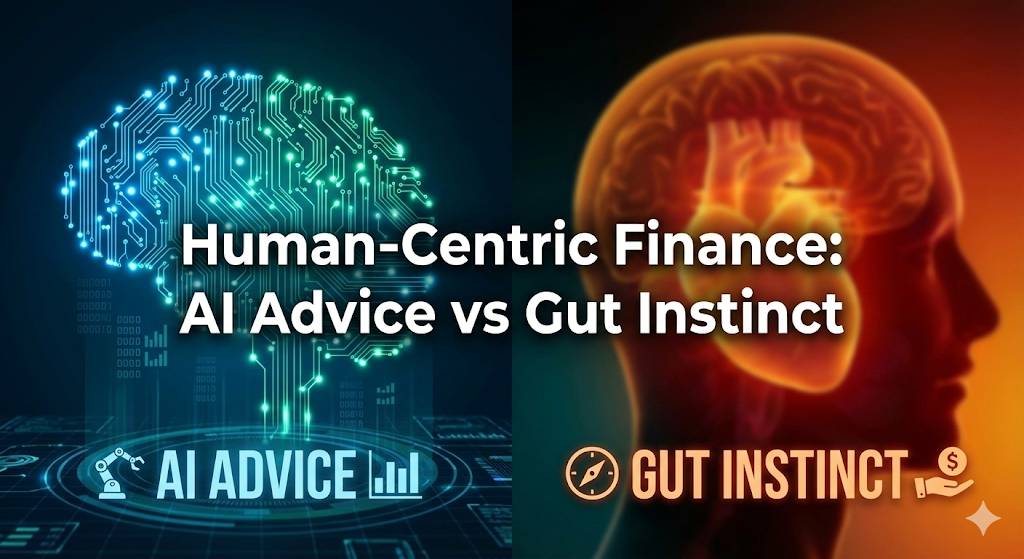
Blend AI money tools with human judgment in 2025-2026: automate smart habits, spot scams fast, and make confident decisions that fit your real life.
The new money tension in 2025
Money has become louder. Prices feel sticky. Subscriptions multiply. Fraud is sharper. Meanwhile, AI tools are everywhere, from banking apps to chatbots.
That mix creates a thrilling promise. It also creates a dangerous trap.
On one side, AI advice feels fast, calm, and data-driven. It can scan statements, flag fees, and draft plans in minutes. It can even coach you through a stressful choice.
On the other side, your gut instinct feels personal, protective, and real. It senses when a decision clashes with your values. It notices when a “perfect plan” ignores your life.
This is the core question for 2025, and it gets hotter in 2026. How do you use personal finance automation without turning your brain off?
Human-centric finance is the answer. It is a practical balance. It is also an emotional one.
Why this matters right now
In 2024, consumers reported more than $12.5 billion in fraud losses, and reported cybercrime losses reached about $16.6 billion. That reality changes how we should trust any “advice,” human or machine.
At the same time, surveys and industry reports show more people using AI for money questions. The adoption is exciting. The risks are real.
Consequently, the smartest move is not “AI only” or “vibes only.” The smartest move is a clear system that makes both stronger.
A quick promise for this guide
You will learn where AI shines, where it fails, and how to build a safe autopilot. You will also learn when to slow down and listen to your instincts.
Importantly, this is educational, not personalized financial advice. Your context matters.
What AI is truly good at in personal finance
AI is not magic. Still, it can feel like a breakthrough when you use it correctly.
Think of AI as a powerful assistant. It can speed up thinking, but it should not replace thinking.
Pattern spotting that humans miss
AI is excellent at scanning messy data. It can categorize spending, find duplicate subscriptions, and spot patterns in your cash flow.
Additionally, it can compare your behavior across months without judgment. That matters when emotions are high.
If you are bleeding money in ten tiny leaks, AI finds them fast.
If your savings rate is drifting, AI can warn you early.
Automation that protects you from yourself
Automation is where AI becomes rewarding. It turns good intentions into default behavior.
For example, rules-based transfers can move money to savings the day you get paid. Alerts can warn you before you overdraft.
Similarly, “round-ups” and micro-savings can make progress feel effortless.
This is essential because willpower is fragile. Systems are steady.
Personalization at scale
Modern tools can tailor suggestions to your goals. They can simulate scenarios. They can show tradeoffs in simple language.
Meanwhile, they can adapt as your income and bills change.
Used well, personalization reduces decision fatigue. It also builds confidence.
The hidden failure modes you must respect
However, AI can fail in ways that feel convincing. That is the scary part.
AI can hallucinate, invent facts, or misread your situation.
Hallucinations and false certainty
A chatbot may sound verified even when it is wrong.
Sometimes, it may cite rules that do not apply in your country.
At other times, it may assume tax laws that changed.
If you follow that advice blindly, the loss can be immediate and painful.
Bias and unfair outcomes
AI can reflect bias in data. That can show up in credit decisions, fraud flags, or risk scoring.
Even when the tool is “accurate on average,” it can be harsh for some groups.
Conflicts of interest inside recommendations
Some “AI advice” is really sales logic. It nudges you toward a product.
That product might be profitable for the platform, not for you.
Therefore, you must ask a hard question: “Who benefits if I follow this?”
What your gut instinct is good at, and where it lies
Your gut is not irrational. It is fast pattern recognition shaped by experience.
Still, it can be distorted by fear, pride, and hype.
Values-based decisions
AI can optimize numbers. It cannot define meaning.
Your instinct helps you choose what you want your money to do.
Do you value safety more than speed?
Would you prefer flexibility or maximum returns?
Are you trying to support family, build a business, or buy time?
Those are human choices. They deserve human weight.
Context that data cannot see
AI cannot fully feel your stress, your job risk, or your family obligations.
It cannot taste the pressure of a sudden medical bill or a school fee deadline.
So, your instincts can protect you from brittle plans.
For example, an “optimal” budget might be too strict to survive real life.
Your gut can say, “This will break.” That warning is vital.
Emotional traps your gut falls into
Nevertheless, instincts can be manipulated.
Fear and panic decisions
When markets drop, fear screams. When prices surge, FOMO screams.
Your gut can push you into buying high or selling low.
Overconfidence
A few wins can create a dangerous feeling of being “special.”
That emotion is thrilling. It is also costly.
Social proof and finfluencer pressure
If everyone online is “getting rich,” your gut may feel behind.
That pressure is intense, especially for younger people.
So you must separate entertainment from verified guidance.
The Human-Centric Finance Framework
You need a system that is simple, repeatable, and safe.
This framework has five layers. Each layer has a clear job.
Layer 1: Protect the basics first
Start with your financial safety rails.
Build a small emergency buffer. Reduce obvious fee leaks. Secure your accounts.
Additionally, write down your “non-negotiables” like rent, food, and critical bills.
This layer is about stability. It is about peace.
Layer 2: Automate the boring wins
Next, automate predictable actions.
Set up automatic bill pay where it is reliable. Use automatic transfers to savings.
If you invest, automate contributions, not predictions.
Automation should feel calm. It should feel like relief.
Layer 3: Create decision triggers
Then, decide which events require a human check.
Use simple triggers like:
- A purchase over a set amount
- Any new debt offer
- Any investment that promises “guaranteed” high returns
- Any sudden policy change in insurance
These triggers are critical. They stop impulsive mistakes.
Layer 4: Use AI as a second brain, not the boss
Now, let AI do analysis and drafting.
Request a summary of options.
Have it list risks.
Then ask it to create a checklist.
However, do not let it press “buy” for you.
A useful rule: AI can suggest. You decide.
Layer 5: Escalate high-stakes choices
Finally, define when you need a human professional.
Complex taxes, large insurance claims, major loans, or retirement planning may require a licensed advisor.
Similarly, if you feel overwhelmed, escalation is smart, not weak.
This layer is about protecting your future self.
Building your personal finance autopilot in 2025
The goal is not perfection. The goal is a reliable system.
This section turns the framework into action.
Cash flow autopilot
Start with the simple question: “Where does my money go each week?”
Use your bank app, spreadsheet, or a budgeting tool to track essentials.
Then, add automation.
The 3-account method, simplified
Create separate spaces for spending, bills, and goals.
Route income into bills first. Send a fixed amount to spending.
Move the rest to goals.
This design is powerful because it prevents accidental overspending.
It also makes your progress visible, which feels rewarding.
Subscription control that feels empowering
Subscriptions are sneaky. They are small but persistent.
Set an AI-powered alert for recurring charges. Cancel anything that is not essential.
Additionally, schedule a monthly “subscription audit” with one clear question: “Did this deliver real value?”
Savings autopilot
Savings is emotional. It represents safety and freedom.
So you want a system that grows without daily effort.
Pay-yourself-first rules
Automate a transfer on payday.
Start small if needed. Increase it with every pay raise.
Consequently, your lifestyle grows slower than your savings.
Goal-based savings
Name each goal. Give it a date. Give it a number.
This is proven to increase follow-through because it makes the goal concrete.
Investing autopilot, without hype
Investing is where AI advice can become dangerous.
That is because confidence and risk often travel together.
Use automation for contributions, not predictions
Automate the habit of investing regularly.
Avoid tools that push frequent trades as “smart.”
Meanwhile, prefer simple, diversified approaches if you invest at all.
Demand explainable reasoning
If a tool recommends an asset, ask why.
Ask what assumptions it used. Ask what could go wrong.
If you cannot understand the explanation, slow down.
Debt autopilot
Debt can be strategic. It can also be brutal.
So you want a plan that is clear and stress-reducing.
The “interest first” lens
List your debts. Sort by cost.
Pay minimums on everything. Attack the highest cost first.
Additionally, automate extra payments to reduce friction.
AI can negotiate, but you must approve
Some platforms help you compare refinancing offers or settlement options.
That can be helpful.
Still, confirm fees, terms, and total cost before you sign anything.
Insurance autopilot
Insurance is often ignored until it is critical.
In 2025, it is also changing fast. Pricing models are evolving.
Climate risk, cyber risk, and health cost pressure are reshaping policies.
Build a “coverage map”
Write what you have, what it covers, and what it excludes.
Then, set reminders to review annually or after life changes.
Use smart shopping carefully
AI can compare quotes and highlight gaps.
However, the cheapest policy is not always the safest.
Focus on coverage quality, claim experience, and exclusions.
Automate claim readiness
Store photos, receipts, and key documents in a secure place.
If a loss happens, you can act quickly and confidently.
Taxes and paperwork autopilot
Paperwork drains energy. Automation saves it.
Use checklists and reminders for deadlines.
Additionally, use AI to draft questions for your tax preparer or insurer.
When AI advice is risky, and your gut is also risky
A balanced system needs honest warnings.
Both AI and instincts can betray you in predictable moments.
The “too good to be true” test
If a tool promises guaranteed returns, instant wealth, or secret tricks, pause.
If your gut feels greedy or rushed, pause again.
Consequently, you create space for clarity.
The “missing context” test
If you did not give the tool your full picture, it cannot give a safe answer.
If you are hiding a detail from yourself, your gut will also mislead you.
The “high-stakes, low-understanding” test
If the decision is big and you do not understand it, slow down.
Ask for plain-language explanations.
Then, verify with independent sources or a professional.
Trust and safety in an AI money world
Trust is not a vibe. It is built with safeguards.
In 2024, fraud and cybercrime losses were serious. That changes the playbook.
So safety becomes a primary feature of personal finance automation.
Identity theft, account takeovers, and deepfake scams
Scammers use urgency.
Some use fear.
Others rely on fake authority.
Many can imitate voices and messages.
Several can spoof emails and numbers.
Therefore, you need simple defenses.
Use strong passwords or passkeys when available.
Turn on multi-factor authentication.
Set transaction alerts.
Freeze credit where your country allows it.
Privacy and data sharing
Open banking and data portability can empower consumers.
It can also expand attack surfaces if done poorly.
So you should share data only with trusted, regulated providers.
Additionally, read what data is shared and how it is stored.
A practical “verification ritual”
Before acting on AI advice, do three checks.
First, verify the source. Second, verify the numbers. Third, verify the incentives.
This ritual is fast. It is also protective.
How regulation is reshaping AI and finance
Regulation is not just politics. It changes product design.
In 2024 and 2025, major policy moves pushed the industry toward more transparency.
That shift should make tools safer over time.
The rise of “trustworthy AI” expectations
In Europe, the AI Act created a new baseline for how AI systems are governed.
In the U.S., debates around consumer data rights and open banking have intensified.
Meanwhile, regulators have increased attention on misleading social media financial promotion.
This matters because rules influence what platforms can do by default.
Over time, transparency and accountability can become standard.
What this means for you as a consumer
You can demand clearer explanations.
You can demand better controls over your data.
You can also expect more warnings and guardrails in apps.
However, regulation is not instant protection.
You still need your own safety system.
2026 outlook: where this balance gets even harder
The next wave is AI agents. They will not just advise.
They will execute tasks across apps. They will pay bills. They will switch services.
This is exciting. It is also high risk if you skip controls.
AI agents and “autopilot drift”
In 2026, many tools will offer “set it and forget it” features.
If you are not careful, autopilot drift can happen.
That means the system keeps working, but it stops matching your life.
Therefore, you will need regular reviews.
Monthly for cash flow. Quarterly for goals. Yearly for insurance.
Real-time payments and instant money movement
Instant payments are expanding. Real-time transfers reduce friction.
They also reduce the time you have to stop fraud.
Consequently, monitoring and alerts become even more essential.
Embedded finance and embedded insurance
More apps will offer financial products inside non-financial experiences.
That can be convenient and empowering.
Still, it can hide fees, exclusions, or conflicts.
So you should compare offers and read the fine print.
The emotional edge becomes the advantage
As AI becomes common, your human skills become differentiators.
Patience becomes powerful. Discipline becomes profitable.
Clarity becomes freeing.
The numbers you should know for 2024-2025
Trends feel abstract until you see the scale.
So here are several signals that explain why this topic is urgent.
AI advice is becoming mainstream
In a 2025 survey cited by the American Bankers Association, 51% of respondents said they already use AI for financial advice or information, and 27% said they are considering it.
That shift is not just hype. It is a behavior change.
Additionally, interest is especially high among younger adults, who are used to asking tools for instant answers.
Separately, an Oliver Wyman Forum survey across many countries found very high interest in using generative AI for planning, and a large share already doing so.
In the UK, Lloyds Banking Group reported that over 28 million adults use AI tools to help manage money.
This matters because “popular” is not the same as “safe.”
When millions adopt a tool fast, scams and mistakes grow fast too.
Robo-advisors are still growing
Robo-advisors are not new. Still, their scale keeps expanding.
Morningstar reports that 2024 robo-advisor assets were roughly $634 billion to $754 billion, depending on the estimate.
Consequently, automated investing is now normal for many households.
At the same time, some firms are rethinking “hybrid” models.
Hybrid services mix automation with access to humans.
They can be helpful. They can also be expensive to run.
So the market is experimenting, and 2026 will likely bring more reshuffling.
Finfluencers are shaping decisions
FINRA Foundation research on U.S. investors found 26% use finfluencer recommendations, and the share was far higher among under-35 investors.
That influence is emotional, fast, and sometimes misleading.
Meanwhile, the most persuasive content often sounds confident, not careful.
Therefore, human-centric finance needs one hard rule.
Never treat viral advice as verified advice.
How to ask AI money questions safely
AI can be a powerful coach if you ask it the right way.
Poor prompts produce vague answers.
Strong prompts produce clear, testable outputs.
Ask for assumptions before advice
Start by forcing the tool to state assumptions.
Ask it to list what it does not know about you.
Then, fill in only what is necessary.
This approach is protective.
It reduces the chance of confident but irrelevant guidance.
Demand a simple checklist
Next, ask for a checklist you can follow.
A checklist is practical and calming.
It also makes errors easier to spot.
For example, you can ask for:
- Questions to ask a lender
- A list of fees to confirm
- A plan to compare insurance policies
Keep the checklist short.
If it feels overwhelming, it will not be used.
Make it translate complex ideas into plain language
Ask the tool to explain every key term in simple words.
Additionally, ask for examples.
If the tool cannot explain it simply, treat that as a warning.
Ask for a “best case, base case, worst case”
Scenario thinking is one of AI’s best features.
It can quickly outline possible outcomes.
However, you still need to decide which risks you can tolerate.
This is where your gut is valuable.
Your instinct can tell you which downside feels unacceptable.
Protect your privacy while prompting
Never paste full account numbers.
Avoid uploading sensitive documents into random tools.
If you must share data, mask it.
Then, use trusted platforms with clear security practices.
A mini crisis drill for modern money risks
You do not need to live in fear.
You do need a simple plan for ugly moments.
If you suspect a scam
Pause immediately.
Do not click links.
Do not send codes.
Instead, contact the institution using an official number you find yourself.
Urgency is the scammer’s favorite weapon.
Calm verification is your shield.
If your account is compromised
Change passwords quickly.
Enable multi-factor authentication if it is not already on.
Check recent transactions and lock the account where possible.
Additionally, document what happened so you can dispute charges.
If AI advice caused confusion or regret
Stop taking new actions.
Write down what you did and why.
Then, verify the key facts with official sources or a professional.
Consequently, you turn a painful moment into a learning win.
The human side that most finance apps ignore
Finance is not only math.
It is identity, safety, and self-respect.
That is why “perfect advice” often fails in practice.
Decision fatigue is real
Too many choices create exhaustion.
Exhaustion leads to avoidance.
Avoidance leads to late fees and stress.
Automation can be liberating here.
It removes daily decisions.
Meanwhile, your human review schedule keeps you in control.
Shame blocks progress
Many people avoid checking balances because it feels painful.
AI tools can help by making the first step less scary.
For example, a gentle summary can feel supportive, not judging.
Still, shame is not solved by a tool alone.
You need small, consistent wins.
That rhythm builds confidence.
Your “money identity” is a strategic asset
A human-centric system reflects who you are.
It aligns spending with values.
It also creates a steady sense of direction.
When your plan feels authentic, you follow it.
When your plan feels fake, you rebel.
That is why gut instinct matters.
Conclusion: the winning blend
Human-centric finance is not anti-AI.
It is pro-safety, pro-clarity, and pro-control.
Use AI for scanning, automation, and planning drafts.
Use your gut for values, context, and warning signals.
Then, use a framework to keep both honest.
Most importantly, build a system you can live with.
A plan that collapses is not a plan.
A plan that survives real life is a breakthrough.
Sources and References
- Consumer Sentinel Network Data Book 2024
- New FTC Data Show Reported Fraud Losses Hit $12.5B in 2024
- Required Rulemaking on Personal Financial Data Rights (CFPB)
- Survey: Consumers increasingly turn to AI for financial advice (ABA)
- Generative AI can make personal finance more personal (Oliver Wyman Forum)
- Best Robo-Advisors of 2025 (Morningstar)
- Over 28 million adults using AI tools to help manage money (Lloyds Banking Group)
- AI Act: Shaping Europe’s digital future (EU)
- European Parliament AI Act text (PDF)
- Investors in the United States: 2024 Investor Survey (FINRA Foundation)
- FedNow Service Quarterly Volume and Value Statistics
- Facts and Statistics: Identity theft and cybercrime (Insurance Information Institute)